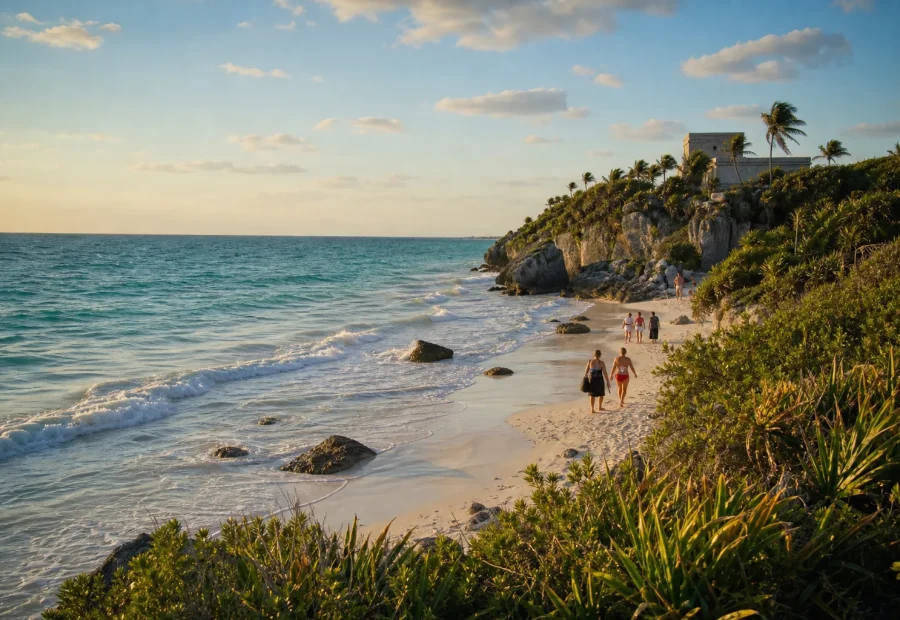
Explore Tulum’s art and design through its strongest verified landmark: the Maya archaeological zone. This practical guide explains how to read the architecture, plan a visit, budget for layered fees, assess accessibility, and approach contemporary venue claims with care.
Tulum’s most dependable design lesson stands above the Caribbean, where a Maya coastal settlement turns architecture, landscape, movement, and proportion into one composition. The archaeological zone provides a stronger verified starting point than an assumed circuit of contemporary galleries. Begin there, then explore newer creative spaces only after confirming each venue’s location, schedule, admission policy, and current program.
- Make the archaeological zone the anchor of your art and design itinerary.
- Schedule the ruins early as a practical response to daytime heat, while treating crowd levels as unpredictable.
- Check official hours, camera rules, and every applicable charge shortly before visiting.
- Ask the site directly about step-free routes and reachable viewpoints if mobility is a concern.
- Verify contemporary museums, galleries, studios, exhibitions, and design venues one by one.
This approach avoids reducing Tulum design to a fashionable palette or a collection of photogenic interiors. The deeper story begins with the relationship between the Maya settlement and its coastal setting. A useful visit pays attention to how structures organize space, how pathways control movement, and how the built environment changes as the sky and sea enter the view.

Tulum Ruins Guided Tour from Cancun and Riviera Maya
- Experience the ancient city of Tulum with our knowledgeable guides. - Enjoy our small group format and attention to detail through the Mayan’s mos...

All-Inclusive! Tulum Ruins, Tequila Tasting + Swim in 3 Cenotes in Small Group!
At Authentic Tours Tulum we believe in giving back to our community by utilizing locations, restaurants, and employees native to our area. Our guides...
Travelers seeking a conventional gallery guide should note an important limitation. The available official evidence does not establish a stable, destination-wide roster of contemporary galleries, studios, public art, or design hotels. This guide therefore focuses on verified heritage architecture and gives you a method for researching newer creative places without presenting an invented “art district.”
Why the archaeological zone belongs at the center
INAH identifies Tulum as a Maya coastal settlement. For design-minded travelers, that setting matters because the site can be read as a complete spatial experience rather than a collection of isolated monuments. Architecture, open ground, circulation, and the coast work together. Even without specialist vocabulary, visitors can observe how built forms frame space and guide attention.
The most useful companion for a first visit is a dedicated Tulum ruins guide covering the archaeological site. Use it to handle the basic visit plan, then bring a design-focused checklist for what to notice. Separating logistics from visual observation leaves more attention for scale, alignment, repetition, edges, entrances, and the relationship between structures and their surroundings.
Look at space before looking at details
Pause after entering and notice the order in which spaces reveal themselves. Ask what appears first, what remains partly hidden, and where your path narrows or opens. Watch how groups of visitors change your perception of scale. This simple exercise turns a sightseeing walk into a study of circulation and visual hierarchy, two ideas that shape both historic sites and contemporary buildings.
Use the coast as part of the composition
Tulum’s coastal position gives the built environment a powerful visual counterpoint. Instead of photographing every structure straight on, step back where permitted and study the balance between masonry, open sky, vegetation, and water. Notice which forms dominate and which seem to recede. The point is not to produce a perfect image. It is to understand how setting changes the way architecture feels.
A field guide to reading Tulum’s design
You do not need architectural training to make close observations. Choose one question at a time and move slowly enough to compare several views. Avoid touching structures or crossing barriers for a better angle. A respectful distance often produces a clearer understanding because it keeps the building, surrounding space, and visitor route in the same frame.

- Begin with silhouette. Identify the simplest outline of a structure against the sky.
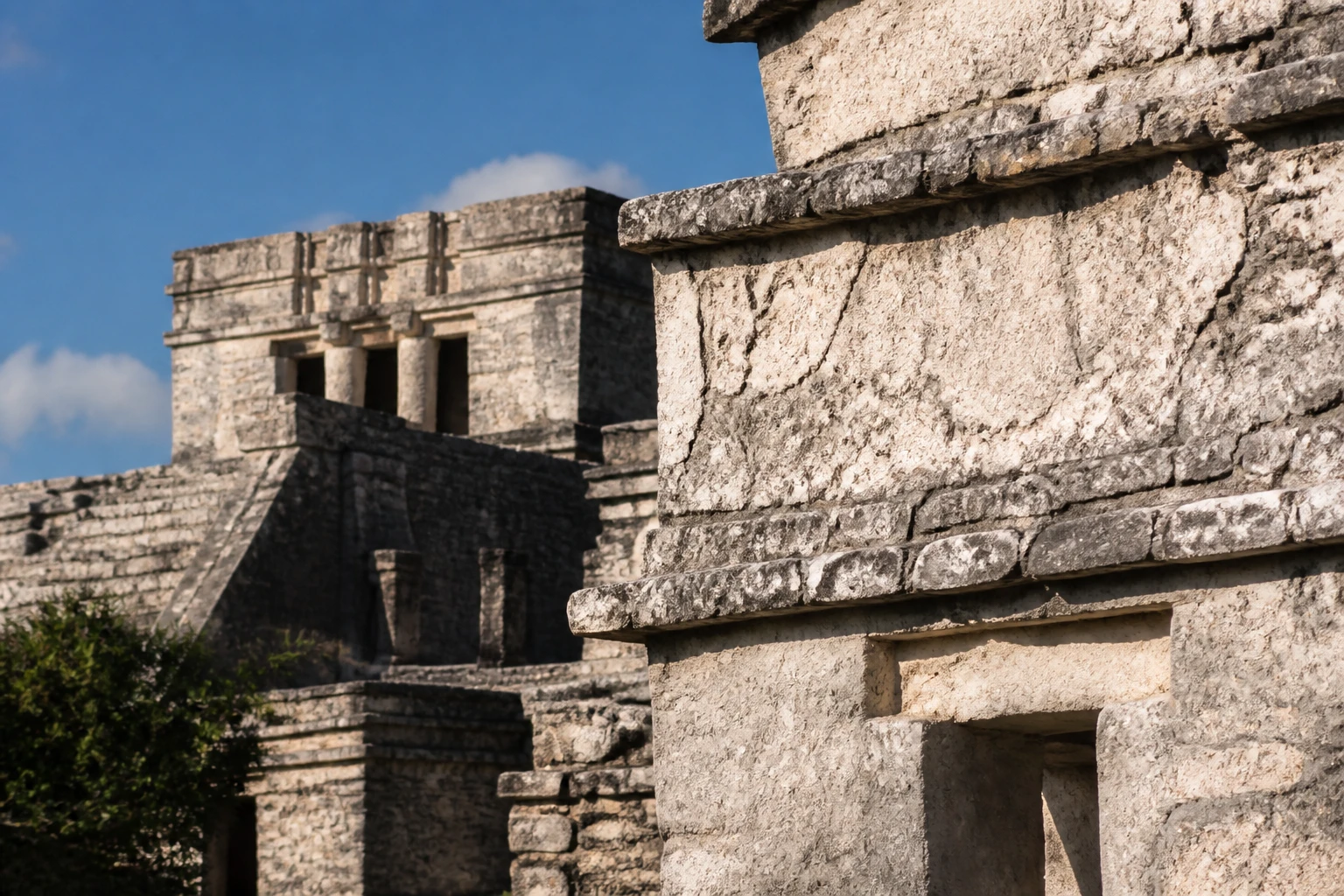
- Study proportion. Compare height, width, openings, and the apparent weight of solid walls.
- Look for rhythm. Notice repeated edges, intervals, steps, or changes in elevation.
- Follow circulation. Observe how the approved path controls approach, pause points, and departure.
- Compare textures. Watch how changing light alters the appearance of stone and surrounding vegetation.
- Finish with context. Step back and consider how the entire built group relates to the coast.
Photograph with a purpose
Create a short visual sequence rather than collecting dozens of nearly identical frames. Take one wide view for context, one medium view for proportion, and one close view only where photography rules and barriers allow it. INAH warns that professional cameras may involve an additional charge, so confirm the current definition, permission process, and fee before arriving with specialized equipment.
Leave drones, elaborate lighting, and commercial-shoot assumptions out of the plan unless you have obtained explicit current authorization. The supplied official evidence confirms only that professional-camera rules may involve an extra charge. It does not establish permission for other equipment or commercial production. A phone or compact personal camera is the simpler planning choice, subject to posted rules on the day.
Tulum Ruins Guided Tour from Cancun and Riviera Maya
- Experience the ancient city of Tulum with our knowledgeable guides. - Enjoy our small group format and attention t...

Tulum Instagram Photo Experience
Discover the most Instagrammable spots in Tulum carefully selected for this unique experience. Elevate your Instagr...
All-Inclusive! Tulum Ruins, Tequila Tasting + Swim in 3 Cenotes in Small Group!
At Authentic Tours Tulum we believe in giving back to our community by utilizing locations, restaurants, and employe...
When to visit and how to pace the ruins
At the research date, INAH listed daily hours of 8:00 a.m. to 5:00 p.m., with last entry at 3:30 p.m. These details are volatile and should be checked again shortly before departure. Arriving early is a practical way to reduce exposure to stronger daytime heat, but no authoritative crowd forecast was retrieved. Do not assume any hour will be empty.
Give the visit enough breathing room to stop, observe, and retrace a few visual ideas along approved routes. Avoid building a rigid minute-by-minute schedule because entry procedures, walking pace, weather, and visitor volume can vary. If this is one stop in a one-day Tulum itinerary, place it before activities with fixed afternoon reservations and leave a buffer between locations.
What to bring for close observation
- Water and sun protection suited to an exposed outdoor visit
- Comfortable footwear for walking on the available site routes
- A small notebook or offline notes app for sketches and observations
- A compact camera or phone, used according to current site rules
- Minimal gear that is easy to carry without blocking paths
A notebook changes the tempo of a visit. Sketching a rough silhouette or writing three words about proportion can make a structure more memorable than another rushed photograph. Artistic skill is irrelevant. The goal is to notice relationships that disappear when the entire visit is experienced through a screen.
Tickets, layered charges, and camera costs
Do not budget for a single archaeological admission price. Official information describes multiple charges that may include INAH admission as well as separate GAFSACOMM and CONANP fees. The two official INAH pages available for this research also display conflicting base-admission figures. An accurate all-in total therefore depends on current rates, visitor category, and the charges applied at purchase.
Check the official listing shortly before your visit and confirm the full amount before paying. Ask what each charge covers, which exemptions apply, and whether your camera equipment changes the price. This matters for groups because a small misunderstanding can multiply across several travelers. Keep room in the budget for changes rather than relying on an old screenshot or social post.
Sunday access needs careful interpretation
INAH states that Mexican citizens and foreign residents of Mexico receive free access to archaeological zones on Sundays. That policy concerns archaeological-zone admission. It should not be interpreted as proof that every separate conservation or access charge is waived. Eligible visitors should carry appropriate documentation and verify all remaining charges under the current policy.
Getting to the archaeological zone
INAH places the site on Federal Highway 307 at kilometer 230 in the Municipality of Tulum. Treat the ruins as a distinct destination rather than assuming they are attached to your hotel, restaurant, or beach plan. Confirm the exact drop-off, pickup, parking, or meeting point with your chosen provider before leaving your accommodation.
The available authoritative research did not establish current bus, taxi, bicycle, shuttle, airport-transfer, or local transport schedules and fares. Use a current Tulum travel tips guide for first-time visitors as a planning framework, but verify the specific route with the relevant operator or accommodation. Build extra time into any connection that depends on a fixed entry or tour appointment.
If joining a guided experience, ask whether the advertised meeting point is at the archaeological entrance, a separate transport pickup, or another location. Also confirm whether the quoted amount includes every required site charge. The official evidence establishes that guided tours are available on site, but it does not supply a complete list of guides, languages, prices, or reservation procedures.
Still comparing Tulum Ruins Guided Tour?
Ask for tour ideas, hotel suggestions, or a simple trip plan that combines both.
Trip Helper
Accessibility and route planning
INAH marks the archaeological zone as offering accessibility services and identifies accessible pathways beginning after the entrance. It also lists on-site toilets. However, the official information retrieved does not describe the entire step-free route, surface conditions, wheelchair availability, accessible transportation, or which viewpoints a traveler can reach.
Travelers with mobility, balance, stamina, or sensory concerns should contact the site before committing to a route. Ask about the distance between arrival and the accessible pathway, rest points, companion assistance, toilet access, surface changes, and current closures. A general accessibility label is useful, but it cannot answer individual route questions.
Finding contemporary art without relying on stale lists
Tulum’s contemporary creative venues require venue-by-venue research. The official evidence supplied for this article did not confirm a stable roster of galleries, studios, public-art locations, or design-led hotels. Names, exhibitions, access policies, and operating schedules can change. A long list assembled without direct verification would look useful while creating a fragile itinerary.
For one independently researched contemporary option, consult the SFER IK Museum Tulum guide and then verify its current program directly before visiting. Treat that guide as a starting point rather than proof of a broader district. Do the same for any venue found through a hotel recommendation, social post, magazine feature, or map listing.
A five-point venue verification check
- Confirm that the venue is currently operating at the stated location.
- Check the date and hours for the specific exhibition or program.
- Ask whether reservations, timed entry, or an admission charge applies.
- Confirm photography, footwear, age, and accessibility policies.
- Recheck on the day if the visit requires a substantial detour.
Avoid using “art district” as a navigation instruction unless a reliable current source defines one. Instead, group confirmed venues by their actual addresses and compare them with your accommodation and transport plan. A single well-verified exhibition may be more rewarding than an afternoon spent chasing pins that no longer match what is on the ground.
How to evaluate modern Tulum design thoughtfully
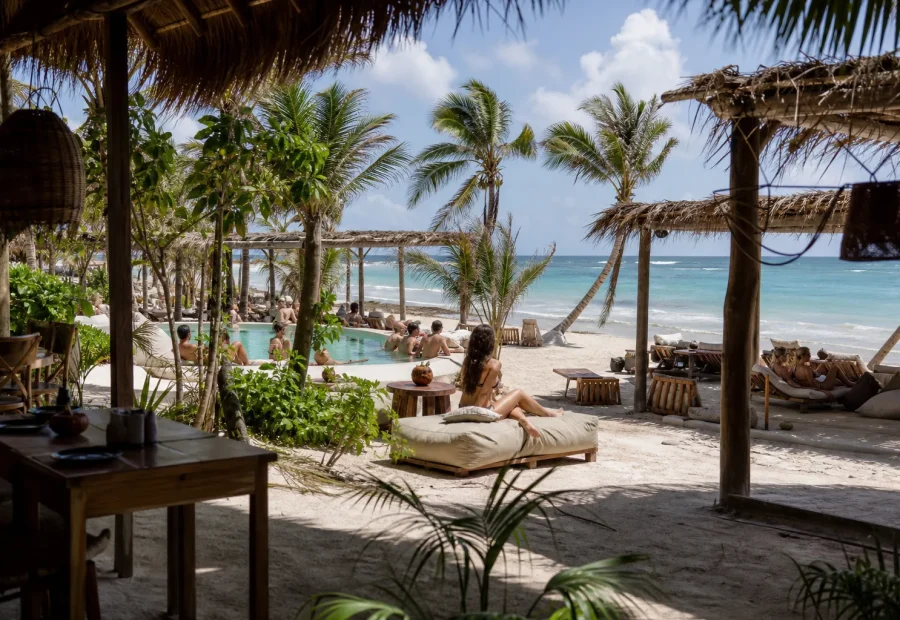
When visiting a contemporary space, look beyond the first photogenic surface. Notice how the entrance handles arrival, how shade and airflow influence comfort, and how materials change between indoor and outdoor areas. Ask whether dramatic forms support the building’s function or mainly create a camera angle. These questions encourage attention without requiring unverified claims about architects, materials, or awards.

Be cautious with broad labels such as “Maya-inspired,” “eco,” “sustainable,” or “handmade.” These terms may describe a genuine practice, a visual reference, or simply marketing. If origin and production matter to a purchase, ask who made the object, where it was produced, which materials were used, and whether the seller can explain the maker’s role.
Buying art and craft with better questions
Ask for the maker’s name and the place of production before buying. Clarify whether an item is unique, made in a small series, or commercially reproduced. For fragile or bulky work, discuss packing and transport before payment. Travelers crossing international borders should independently check current customs and material restrictions for their destination rather than relying on a shop’s general assurance.
Tulum Ruins Guided Tour from Cancun and Riviera Maya
- Experience the ancient city of Tulum with our knowledgeable guides. - Enjoy our small group format and attention t...
Tulum Instagram Photo Experience
Discover the most Instagrammable spots in Tulum carefully selected for this unique experience. Elevate your Instagr...
All-Inclusive! Tulum Ruins, Tequila Tasting + Swim in 3 Cenotes in Small Group!
At Authentic Tours Tulum we believe in giving back to our community by utilizing locations, restaurants, and employe...
A flexible art and architecture itinerary
Start at the archaeological zone near opening time after confirming the day’s operating details. Use the first part of the visit for broad spatial views, then revisit one or two structures through the design checklist. Before leaving, record a few observations about proportion, movement, texture, and setting. This creates a visual reference for comparing heritage architecture with any contemporary space visited later.
Reserve the afternoon for one confirmed museum, exhibition, studio appointment, or design-focused interior where public access is clear. Do not stack several speculative stops. If no contemporary venue can be verified, spend the time reviewing sketches, organizing photographs, or exploring another established Tulum attraction rather than forcing an unreliable art crawl.
The result is a more honest Tulum art and design day. Its foundation is a verified Maya coastal site, while newer creative work remains open to discovery through careful current research. That balance respects both the depth of the built landscape and the practical reality that contemporary venues can change faster than a travel article.
Frequently asked questions
Does Tulum have an official art district?
The available official evidence does not establish a stable, destination-wide art district or roster of contemporary galleries and studios. Verify each venue individually instead of planning around an assumed district.
What is the best verified place to explore Tulum design?
The Tulum archaeological zone is the strongest verified anchor. It presents the built environment of a Maya coastal settlement and can be studied through its spatial organization, circulation, proportions, and relationship with the coast.
What time does the Tulum archaeological zone open?
At the research date, INAH listed daily hours of 8:00 a.m. to 5:00 p.m., with last entry at 3:30 p.m. Hours are subject to change, so confirm them directly with INAH shortly before visiting.
How much does it cost to visit the Tulum ruins?
There is no reliable single total in the supplied evidence. Official information describes layered INAH, GAFSACOMM, and CONANP charges, while two INAH pages conflict on the base admission figure. Check the full current total for your visitor category before arrival.
Are the Tulum ruins free on Sunday?
INAH states that Mexican citizens and foreign residents of Mexico receive free archaeological-zone access on Sundays. This does not necessarily waive every separate conservation or access charge. Eligible visitors should verify the current conditions and bring appropriate documentation.
Is the Tulum archaeological zone wheelchair accessible?
INAH identifies accessibility services and accessible pathways beginning after the entrance, but the available information does not explain the complete step-free route, surfaces, wheelchair availability, accessible transport, or reachable viewpoints. Contact the site with specific mobility questions before visiting.
Can I use a professional camera at the ruins?
INAH warns that professional cameras may carry an additional charge. Confirm the current definition of professional equipment, the applicable fee, and any permission requirements before bringing specialized gear.
How should I verify a contemporary art venue in Tulum?
Confirm its current location, exhibition dates, public hours, admission or reservation policy, photography rules, and accessibility directly with the venue. Recheck on the day if reaching it requires a substantial detour.
Tulum Ruins Guided Tour from Cancun and Riviera Maya
- Experience the ancient city of Tulum with our knowledgeable guides. - Enjoy our small group format and attention to detail through the Mayan’s mos...
All-Inclusive! Tulum Ruins, Tequila Tasting + Swim in 3 Cenotes in Small Group!
At Authentic Tours Tulum we believe in giving back to our community by utilizing locations, restaurants, and employe...